Friday, January 6, 2023

The Light Still Shines


    Epiphany is one of the oldest days of celebration recognized by the church – they celebrated     the Day of Epiphany for several hundred years before anyone thought of celebrating the day        of the birth of the baby Jesus. 

    Truth be told, I think we should do far more with the twelve days of Christmas and Epiphany        than we do. 
 

   The deepest satisfactions in life are not those objects of gold, frankincense or myrrh . . .
   The secret lies not in our possessions,

   but in taking possession of ourselves.
   It's the light that burns from within that truly counts.

Isaiah 60:1-6
Matthew 2:1-12
 
Maybe you heard the story about  the elephant who was thoroughly enjoying himself as he splashed about in the river.
And a mouse ran up to the sandy shore.
It was obvious that the mouse was agitated and disturbed about something.
And, the mouse yelled at the elephant, "Come out of the water now."
The old elephant  laughed and said, "Why should I come out?"
The mouse was not about to be humiliated by this mountain of flesh. He kept yelling and yelling.
The elephant realized that if he wanted any peace and quiet he had better come out of the water.
So, slowly the elephant lumbered out of the water and stood on the shore towering over the mouse.
And spoke: "Now, why did you want me to come out of the water?"
The mouse looked up and said, "I wanted to see if you were wearing my bathing suit."

Of course, it is a nonsensical story,
but the theological punch line is this:
It is easier for us to understand how an elephant could wear the mouse's bathing suit than it is for us to understand the awesome mystery of the incarnation – Emannuel – God's Word became flesh. 
The God of all creation became a tiny babe in a manger.

The church recognizes the Day of Epiphany as being January 6 – the first day after the twelve days of Christmas – but, most churches celebrate on the Sunday closest to January 6.
(So, sometimes Epiphany Sunday is a couple of days before, and sometimes a couple of days after January 6.)

    It may surprise you to know that many cultures of the world make far more to do over the twelve days of Christmas and Epiphany than they do over Christmas day itself. 
In fact, Epiphany is one of the oldest days of celebration recognized by the church – they celebrated the Day of Epiphany for several hundred years before anyone thought of celebrating the day of the birth of the baby Jesus.
Truth be told, I think we should do far more with the twelve days of Christmas and Epiphany than we do. 

 So today, on this Epiphany Sunday, we remember the story:
We remember that thousands of years ago those mysterious strangers were heading toward Bethlehem.
As everyone knows, they came to Bethlehem "following yonder star." 


According to convention they were three kings who made their way to the stable where Jesus was born.
They made their journey in fulfillment of the prophecy of old:
"The Lord will rise upon you and God's glory will be seen over you. The nations will come to your light, even kings to the brightness of your rising."
According to tradition those kings had decoded the secrets of the stars;
they realized that the mysterious light in the sky brought news of a  new ruler.
So they traveled toward Bethlehem in homage to the one who would eventually rise to a position of preeminence and power.
But when the magi told their story to King Herod it touched off his paranoia and fear.
Suspecting that Herod would want this pretender to the throne put to death, the three visitors paid a brief visit to the manger,
left their gifts of gold, frankincense and myrrh,
but departed for home by another way.

So three ancient monarchs followed a star to a place  where a child was born... so what?

What does that series of events so long ago have to offer us, here in the modern world where star-gazing and even the title of King seem to convey such little power?

You have, no doubt, heard that is the oft quoted advice of Ralph Waldo Emerson:
Hitch your wagon to a star.

Hitch your wagon to a star. 
That was the philosopher's way of saying that all of us need high ideals, a commanding sense of purpose, great ambitions.

Well, these days, we are pretty apprehensive, aren’t we?
I don’t know about you, but before hitching my wagon to a star, I’ve learned that I'd better take a closer look at the fine print.
I'd like to read the warning labels and make  sure what kind of an adventure I'm signing up for.
Before heading off into parts unknown, I'd like to check and see that  the fail safe systems are in order, [wouldn’t you?]
that the seat belts are fastened,
and above all, that the landing gear is operational.

In fact, the story of Epiphany reveals as much about the dangers of star gazing as its promise.

A careful reading of the Bible reveals a number of telling details.

First, we notice that those strange and mysterious visitors to Mary and Joseph and the new baby,  are nowhere referred to as kings.
Nowhere is it specified that there were three royal visitors to the Christ child.
Though most modern versions of the Bible translate the Greek word as “wise men” – one calls them a band of scholars, another “some men who studied the stars”,  the word is magi – the same Greek word that we use for magician – and magic.
And again, it's plural, to be sure, but we just don't  know how many of them there were;
one ancient source puts their number at twelve – another at 120.
And the group might easily have included women.
(Only hundreds of years after the fact have we come to imagine three kings beside the manger. )

In fact, these magi were a common sight in the Middle East of that time.
Magi traveled constantly throughout the Mediterranean world, sometimes playing the part of sorcerers and magicians,
sometimes practicing the burgeoning science of astronomy,
sometimes selling their services as interpreters of dreams, and/or purveyors of wisdom and enchantment in the court of many a monarch.

The magi were descendants of the Medes, a people who once constituted a great empire.
But the Medes were conquered by the Persians and so they lived as a subject people.
Once they mounted a rebellion against their Persian oppressors,
but they were hopelessly overpowered and the rebellion was crushed.
And, from that hour the Medes were relegated to the sidelines of history,
their kings and queens became the gypsies of the ancient world.
They were ministers without portfolio,
They were kings without a country,
They were queens without a crown.
They turned to the stars for guidance because they had no armies,
they had no subjects,
they had no territory to call their own.
They would turn up in all the palaces of the empire ingratiating themselves to the real potentates of the world, but they had no province of their own.

The magi had become prisoners of their own dreams,
hoping beyond hope to recover the lost tribes and territories.
By sheer exertion of wit and skill they managed to maintain a finger hold in the palaces of the empire, but no matter how successful they became,
they could not forget the basic fact that they were a defeated people.

But, then one day the magi of our story saw a star shining in the east.
They saw a strange light on the horizon, and for one last time, the dream of glory beckoned within them.
Once again they gathered their belongings,
they packed their camels,
they carefully wrapped those trinkets of gold, frankincense and myrrh,
and mounted their horses [most certainly, folks of their class and ilk would not ride camels] and they headed out, following yonder star.

Now this is one of the major points of this story, and one of the reasons it is told again and again every year at this time, [don’t miss it]
Like everyone else in the world –
like everyone else in Bethlehem at the time –
like everyone else in Jerusalem –
like everyone else in Rome or in Egypt –
like everyone else in the world – 
Until this encounter with the Christ child, they believed that the favors of God belonged to the rich, the powerful and the mighty.

But in Bethlehem they saw the truth.
All of us -
all people -
are simply lost souls looking for a star that will not fail.

And there is no star in the sky that will lead us to the truth.
He is the bright morning star that rises in our consciousness.
He is the light that shines when we see that God has found a dwelling place within us.

And so they turned over their gold, frankincense and myrrh,
not in tribute to a new king,
but in the realization that they would no longer need these trappings of their former life.

Some scholars have even suggested that the gold, frankincense and myrrh were not meant as gifts. Rather these were the tools and instruments of their magical arts.
These were the props they used in spinning their illusions of power.
But what they found in that stable in Bethlehem made these paraphernalia of an ancient superstition suddenly obsolete.
No longer would the magi search in vain for the glory of a forgotten empire.
Now they could live as a free people knowing that God has a sure  foothold in the here and now.
All the light we need is here within us.
If only we have the faith and courage to look and see!

When we read the story of the magi carefully
everything is turned around 180 degrees.
This baby Jesus is not glorified because kings come to do him honor,
rather these  would-be kings are liberated from their dreams of power and glory and they leave Bethlehem a free people.

More truly free then they had ever been even in former days of imperial majesty.

Now that the hustle and bustle of Christmas are behind us,
now that the ritual of exchanging gifts is past,
you and I are free to receive the true gift of this season.
And that is the same gift which the magi received so long ago in a crowded manger.
In Christ we are freed from the necessity to shore up our lives with the trappings of wealth, power, fame or other forms of stardom.

The deepest satisfactions in life are not those objects of gold, frankincense or myrrh,
not those dvd players,
not those fancy cars,
not those Oscars,
not those superbowl championships or any other honors that the world has to give.

The secret lies not in our possessions,
but in taking possession of ourselves.
It's the light that burns from within that truly counts.

Rather than searching the distant stars for the secrets of our destiny as the magi did,
we need only survey the quiet places of our own hearts.

It is appropriate that we celebrate this season, not with relics of gold, frankincense or myrrh, the trinkets of astrologers.
Instead we turn to the simplest of things,
a word of truth,
a song,
a prayer,
a warm welcome to ones we love,
the struggle to do the work of justice and to fulfill God's promise of peace.
It is about Emmanuel! 

In the birth of this baby Jesus,
God has come as close to us as the bones of our own bodies,
as near as the blood coursing through our veins.

He is our bright morning star,
a light that shines within our hearts even when all else fails.

Let us not hitch our wagons to any lesser star than this!

Amen.

The congregation of Christ Presbyterian Church in Drexel Hill, Pennsylvania, USA, experienced this sermon during a worship service on Epiphany Sunday, January 8, 2012.


Thursday, January 5, 2023

Happy Epiphany


The church recognizes the Day of Epiphany as being tomorrow – the first day after the twelve days of Christmas.

It may surprise you to know that many cultures of the world make more to do over the twelve days of Christmas and Epiphany than they do over Christmas day itself.

In fact, Epiphany is one of the oldest days of celebration recognized by the church – they celebrated the Day of Epiphany for several hundred years before anyone thought of celebrating the day of the birth of the baby Jesus.

Truth be told, I think we in the US of A should do far more with the twelve days of Christmas and Epiphany than we do.

Sunday, January 1, 2023

The 8th Day of Christmas: A Day the Lord Has Made


It’s a good thing we begin a new year every year about this time, don’t you think?

If properly approached, the beginning of a new year can be beneficial to our psyche,
beneficial to our health, and beneficial to our soul.

However, as the years go by, Father Time becomes more of a caricature, and we pay less and less attention to the intention  of the season, don’t we?

Without the fol-de-rol of late night parties, New year’s Eve is of little importance to the on-going nature of our lives. 
We have no ceremony for this time of year, when a youngster may ask, “Why is this night, of all nights, important to us?” 

But, maybe we should. 
For this could be a teaching moment for all of us.

As I have noted before, most of us carry around way too much baggage.  We tend to tote pounds and pounds of grudges, animosity, resentment, and revenge, don’t we?
 
And, we know it’s unhealthy. 
Doctors tell us. 
Ministers tell us. 
Researchers tell us. 
Some friends tell us. 
Our blood pressure is affected. 
Our cholesterol is affected. 


Our heart rate is affected. 
Our mood is affected. 
Our relationships are affected. 
Our outlook is affected. 
Our immune system is affected. 
We become more prone to disease. 
We become more prone to mental disorder. 
We become more prone to grumpiness. 
And, our life is not what it could be. 
Our life is not what it should be. 
Our life is not what it is promised to be.

Dr. Bernie Siegel reminds us that there seems to be an innate desire in all humans to be reborn, to start again,
to make resolutions and changes we can live up to.

He notes that he sees evidence of this deep seeded desire
“every day in my role as a physician:
People learn they have a limited time to live, and they start their New Year behavior.
They move, change jobs, spend more time with those they love, stop worrying about what everyone else thinks of them, and start to celebrate their life. They are grateful for the time they have to enjoy life and they stop whining about what they wish had happened during the past year.”

So, he notes: we don’t need to wait for that one certain day of the year.

Dr. Siegel suggests that everyday can be the beginning of a new year.
When every evening is New Year’s Eve and every day you awaken is New Year’s Day, you are living life as it was intended.

For me, this is the message of the new year. 

As Paul reminds us in Colossians, it is time to put to death old attitudes and agendas.

Then, the new year has meaning.  

Then, the new life we are promised is closer to being fulfilled.

In this way, we nurture our soul. 
And, when our soul is tended, our health is better and our future is brighter.  
Then, and only then, can we truly welcome the new year and the days ahead. 
We know them to be the fulfillment of God’s time.

This is the day the Lord has made. 

When every evening is New Year’s Eve and every day you awaken is New Year’s Day, you are living life as it is intended.

Monday, December 26, 2022

For The Time Being


Poet W.H. Auden wrote For the Time Being: A Christmas Oratorio in 1941 and 42 in war-torn England.
For over fifty Christmases I have read this poem - sometimes to myself, sometimes with family, sometimes with congregations I have served.  Needless to say, it speaks to me in a profound way.  And I share it here with you that you might find some inspiration.
 
Well, so that is that. Now we must dismantle the tree,
Putting the decorations back into their cardboard boxes --
Some have got broken -- and carrying them up to the attic.

 
The holly and the mistletoe must be taken down and burnt,
And the children got ready for school. There are enough
Left-overs to do, warmed-up, for the rest of the week --
Not that we have much appetite, having drunk such a lot,
Stayed up so late, attempted -- quite unsuccessfully --
To love all of our relatives, and in general
Grossly overestimated our powers. Once again
As in previous years we have seen the actual Vision and failed
To do more than entertain it as an agreeable
Possibility, once again we have sent Him away,
Begging though to remain His disobedient servant,
The promising child who cannot keep His word for long.


The Christmas Feast is already a fading memory,
And already the mind begins to be vaguely aware
Of an unpleasant whiff of apprehension at the thought
Of Lent and Good Friday which cannot, after all, now
Be very far off. But, for the time being, here we all are,
Back in the moderate Aristotelian city
Of darning and the Eight-Fifteen, where Euclid's geometry
And Newton's mechanics would account for our experience,
And the kitchen table exists because I scrub it.
It seems to have shrunk during the holidays. The streets
Are much narrower than we remembered; we had forgotten
The office was as depressing as this. To those who have seen
The Child, however dimly, however incredulously,
The Time Being is, in a sense, the most trying time of all.
For the innocent children who whispered so excitedly
Outside the locked door where they knew the presents to be
Grew up when it opened. Now, recollecting that moment
We can repress the joy, but the guilt remains conscious;
Remembering the stable where for once in our lives
Everything became a You and nothing was an It.
And craving the sensation but ignoring the cause,
We look round for something, no matter what, to inhibit
Our self-reflection, and the obvious thing for that purpose
Would be some great suffering. So, once we have met the Son,
We are tempted ever after to pray to the Father;
"Lead us into temptation and evil for our sake."
They will come, all right, don't worry; probably in a form
That we do not expect, and certainly with a force
More dreadful than we can imagine. In the meantime
There are bills to be paid, machines to keep in repair,
Irregular verbs to learn, the Time Being to redeem
From insignificance. The happy morning is over,
The night of agony still to come; the time is noon:
When the Spirit must practice his scales of rejoicing
Without even a hostile audience, and the Soul endure
A silence that is neither for nor against her faith
That God's Will will be done, That, in spite of her prayers,
God will cheat no one, not even the world of its triumph.

IV
Chorus

He is the Way.
Follow Him through the Land of Unlikeness;
You will see rare beasts, and have unique adventures.

He is the Truth.
Seek Him in the Kingdom of Anxiety;
You will come to a great city that has expected your return for years.

He is the Life.
Love Him in the World of the Flesh;
And at your marriage all its occasions shall dance for joy.

-- W. H. Auden

Thursday, December 15, 2022

Our Own Story of Christmas


Isaiah 52:7-10
John 1:1-14


So, it's almost Christmas.  For us in the church, this is the Fourth Sunday of Advent – a time for us to contemplate why we celebrate Christmas anyway.
Again, this year, during these weeks before Christmas, we have been looking at the very earliest documents we have to ascertain just how those earliest Christians celebrated Christmas –
hoping to find clues as to how we might have a better understanding and actually experience a better Christmas this year.

The first week of Advent, we looked at the very earliest writings we have –
the letters of Paul and some of the writings that were found in the Dead Sea Scrolls and Nag Hammadi and other places in the desert country of Egypt and Syria and Palestine,
and the very earliest Gospel in our Bible:
the Gospel of Mark – which was published around the year 70.

We actually have several texts now that were published during these early  years – during the first 75 years or so after Jesus was killed.
And, look as we may, it is obvious that none of these texts say anything at all about the birth of Jesus.  It just was not important to them.

Yes, Jesus was a pivotal figure in their history,
yes, Jesus was a pivotal figure in their faith,
yes, Jesus was a pivotal figure in their life experience – in their understanding of who they were and what they to do.
Clearly, they each articulate a faith that in Jesus, they saw God incarnate – God in the flesh – for them,  Jesus was Emmanuel – God with us.

The second week we looked at the second Gospel, the Gospel of Matthew, published some 15 years after Mark, and intended for a somewhat different audience.
Matthew begins his Gospel with a detailed genealogy setting Jesus firmly in the Jewish camp – a descendent of King David,
and even Father Abraham, himself.

In the 15 years between Mark and Matthew an interest in birth stories had developed.
Matthew’s community wanted to believe that their Jesus was no less a god than the mighty Caesar or any of the other gods they encountered among the cosmopolitan culture of the Roman Empire.
Every other god had a miraculous birth story to show their specialness, so, Jesus should have one, too.

The Gospel of Luke is the third Gospel of the collection in our Bible.
It was published some 15 years after Matthew.
And, again, it was intended for a different audience than Mark or Matthew.

Again, we are reminded that during these early years, indeed, for the first 100 to 150 years, there was no separate Christian church.
There were Jews who believed that Jesus was the Messiah and revered as Emmanuel – God with Us – and they would meet as small groups –
sometimes even sharing meals and resources and living arrangements –
but, when they worshiped, they went to the Temple.

We see Luke being addressed primarily to a predominately gentile audience to show that belief in Jesus in Emmanuel conflicted in no way with their ability to serve as good citizens of the Roman Empire.

And, we see that each of the Gospels have a very different starting place.
Matthew starts very differently than Mark does – again with that long genealogy.
And Luke starts differently than either Mark or Matthew does with that miraculous birth story – not of Jesus, but of John.
And, here in the Gospel of John, we have an even stranger beginning.

Most scholars agree now that this Gospel of John was published around 110 years after the death of Jesus.
Clearly this Gospel was addressed to people under stress –
there was a conflict between the communities of believers in Jesus as Messiah
and the communities of believers in John as Messiah;
and there was a widening rift between these communities of Jesus believers and the other believers of Judaism.
The break that we know today was occurring.
And this Gospel is written in that context.

Again, dwelling on establishing the specialness of Jesus with stories of his birth was not important to these people.
What was important, was how their faith in this radical new religion based on Emmanuel – based upon the Incarnation – based on God now being with us instead of dwelling from on high –
how life based on this new faith fits into the cosmic scheme of things –
and how it is different from the old ways of doing.

Curiously, we know from the writings of a Jewish Greek philosopher from Alexandria, Philo, that this concept of God as the Doer, the Speaker, the One who Acts, the Word was emerging in Alexandria some 50 years before the Gospel of John was published.

Here, Jesus is remembered not primarily as a specific man at a specific time in history, but
as the embodiment of a wisdom, a sophia, that pervades all things and all people.
The Word has existed from the beginning, and the Word came and dwelt among people, “they knew him not.”
Here, John tells the story in a radically new way.
Jesus is identified with the Logosthe Word of God –   and becomes something other than a man from Nazareth born of flesh and blood –
but nothing less than a construct of God –
a part of Almighty himself –
a very part of the cosmos itself.

Like I concluded last week,
I think it is important for us to ask why the Gospels treat the birth of Jesus differently.
And to remember that the story that you and I have learned and could tell on a moments notice, actually does not occur in any of our gospels.

The story you and I learned,
and the story you and I tell,
is really a composite of the stories we see in the Gospels.
We tend to take a part from one and combine it with a part from another and a part from another, and lo, we have our story.

But, if we actually did what those early Christians did, we wouldn’t revere any of the details of any of these stories;
but, we would come up with our own story – like they did.
A story that begins with an experience with Emmanuel
an experience of God being with us
and then coming up with an explanation as to how special that experience is.

For you and me to fully understand and celebrate Christmas, we have to seek out and identify times of Emmanuel for us:
times we have been in the presence of God,
times we when we have been absolutely convinced that God is with us.

And, so we say "Where, oh where, is Emmanuel today?"
And we are on the lookout for signs of Emmanuel in our times:
for some, like the shepherds in Luke’s Gospel, it is in celestial music;
for some, it will be in coming to the Lord’s table as we do today;
for some, it will be in helping feed the hungry at the food closet;
for some, it will be in sharing special time with loved ones;
however and whenever and wherever;
This Christmas will be the best you have ever had when you open yourself to the presence of Emmanuel and recognize God with us.
Amen.


The congregation of Christ Presbyterian Church, in Drexel Hill, Pennsylvania, experienced this sermon (along with the other sermons referenced here) during Advent of 2006.  
Clyde E. Griffith, pastor

Friday, December 9, 2022

Whose Birthday Is It Anyway?


No one knows when Jesus was born . . .
    No one kept a record – maybe he never told anyone – we don’t know
    It just was not important to them.
There is no record of the Disciples ever singing happy birthday to Jesus.


Ready or not, Christmas is coming. 
With every catalog we get in the mail,
with every card we receive,
with every Christmas song we hear in the stores and on the radio,
with every television special we see,
with every advertisement we see and hear and read,
with every invitation we receive,
we know Christmas is on the way.
And, it will come, whether we are ready or not.
And, so we begin to get somewhat anxious about it all, don’t we?

It is almost as though there are two Christmases:
one of the lights and trees and decorations and presents and reindeer and parties and snowmen –
and . . . .  

and . . . . 

and . . . .
The one we talk about in church.

Sometimes, it seems that the two Christmases are not even of the same wavelength.

We know the Christmas story that most of the world around us celebrates – and we know it well – and we participate in it willingly and knowingly – often for very good reasons. 
We like the feeling that comes with giving and thinking about others and going out of our way to make someone’s day. 

But, you know, the earliest Christians did not celebrate Christmas.
    It just was not important to them.

No one knows when Jesus was born . . .
    No one kept a record – maybe he never told anyone – we don’t know
    It just was not important to them.
There is no record of the Disciples ever singing happy birthday to Jesus.

Of course, the first Christians knew Jesus,
they lived with Jesus,
they heard Jesus talk,
they saw Jesus laugh,
they felt Jesus hurt,
they saw Jesus sleep and eat and drink and do all kinds of bodily functions –
they experienced a living breathing person just as you and I experience each other. 

But, after a few hundred years, some believers began to question whether Jesus ever really lived at all.  
He was being remembered and worshiped as more of a god – than remembered as a real living breathing man who lived and died during certain days and years of the Roman Empire.

So, a small faction began to think it was important not to forget that Jesus was a real person. 
And if he was, we ought to remember when he was born. 
Trouble was, nobody knew when Jesus was born.

The very earliest writing we have in the New Testament is a letter from The Apostle Paul, written around the year of 35 AD.
The earliest Gospel we have is attributed to Mark.  The Gospel of Mark was most probably published around the year of 50 AD. 
In the past 70 years, many other documents have been discovered that date back to the very first decades after Jesus’ death.
When we read these documents looking for what they say about the birth of Jesus, we discover one thing in common. 
None of them have anything to say about the birth of Jesus.  Nothing.
It simply was not important to them.

A strong vocal faction of early believers thought it was just plain wrong to celebrate Jesus’ birthday – because that was too much like the world around them did when they celebrated the birthdays of the pagan gods, the Caesars and the Pharaohs.

But, there appeared a major debate in the middle of the third century.
Whether or not we would celebrate it, it would be nice to know when Jesus was born. 
So the speculation began. 
After a careful study of scripture, one prominent theologian of the third century calculated the birth date of Jesus must be May 20 [Clement of Alexandria (c.150-c.215)]
The debate began.  Others calculated that it must have been  April 18,
others thought it was April 19, and
still others were fairly certain it was  May 28.
One of the leaders of a powerful faction thought Jesus’ birthday should be remembered as
January 2 [Hippolytus (c.170-c.236)]
Others calculated it to be November 17,
others November 20, and
some, March 25.
And, so it went. 
It took over 300 years for the church leaders to agree on a date of December 25 to recognize as the birthday of Jesus.

And, even at that point, the believers were at odds with the culture around them.
Most of the world already celebrated major festivals on December 25:
the natalis solis invicti (the Roman "birth of the unconquered sun"),
and the birthday of Mithras, the Iranian "Sun of Righteousness" whose worship was popular with Roman soldiers.
The winter solstice, another celebration of the sun, fell just a few days earlier.
There were a lot of major celebrations going on at this time of year in most of the cultures of the world – and they had nothing to do with the church.
So, many believers thought it would be most inappropriate to celebrate Christmas at all.

And, in fact throughout history, there are long periods of years when nobody celebrated Christmas at all.
But, Christians have always had an uncanny ability to find ways to celebrate. 
And, in almost every culture where Christians found themselves, they appropriated local events and customs and made them their own.
And, oftentimes there were movements that would spring up to convince believers they should not participate in the cultural seasonal festivities –
sometimes by trying to convince people to remember the reason for the season,
sometimes by campaigning to put Christ back in Christmas,
sometimes by actually passing laws to ban Christmas celebrations altogether!

Imagine that, outlawing Christmas!
In the seventeen century, you may recall, Christian religious zealots took over the government of England. 
Oliver Cromwell and his Puritan Party actually passed legislation that outlawed Christmas. 
To them Christmas had become a time for lavish and raucous celebration and behavior and commercial exploitation – sound familiar? 
So, that was it. 
Plain and simple.
No more Christmas. 
(Sounds like a Dr. Zeus story, doesn’t it?)

And, it gets stranger. 
The people were outraged.
There was rioting in the streets.
Secret Christmas celebrations broke out all over England.
But, Oliver Cromwell retaliated.
Parliament decreed penalties of imprisonment for anyone caught celebrating Christmas.
Imagine that!
Being rounded up and being put in jail because you dared to celebrate Christmas!

Each year the “Christmas Police” would go through the streets a few days before Christmas warning people against celebrating Christmas. 
Businesses were not to be closed during the day  and there were to be no displays of Christmas decorations.

They went around and broke up any sign of Christmas celebration with force of arms. 

And the people rose up.
And the jails filled to overflowing.

The people would not be denied.
They took to the ballot box and voted the Puritans out of power.
Christmas was back.
The very idea. 
Outlawing Christmas.

Meanwhile, over here in the new country, the zealots persisted. 
Christmas was outlawed and not celebrated in many colonies for years. 
In fact, Christmas remained illegal in Massachusetts until sometime after 1850!

So, there is nothing new here. 
It seems that ever since day one, there was some controversy between what the church thought should be remembered and celebrated
and what and how the world around them celebrated.

Recognizing this historical reality doesn’t really do much to ease the conflict today, does it?
Christmas is celebrated in public schools without singing Christmas songs or telling Christmas stories.
All kinds of merchants appropriate seasonal music and messages to sell their products.
And fa-la-las are sung in sync with cash registers.

And, as it so often happened in the past, today the Christmas of the church gets short-shrift in our celebrations.
For the church, Christmas celebrates one of the most fundamental of beliefs – what is called incarnation. 
Specifically, the incarnation of God – that is, literally, God in the flesh. 
What we also call Emmanuel – God is with us!

The profoundness of this message is shown in the beginning words of the Gospel of John:
this is a time to recall that God existed before time began –
and all things that are and that ever will be were brought into existence by God. 
God is described as the eternal logos – the Word with a capital W. 
And John reminds us that this eternal logos, this Word, this God,
came into the world with flesh and blood –
bridged the gap – came to be one of us – came to live with us. 
And that is Emmanuel means.
God is with us. 
– a profound statement, to be sure.

At this time of year we take time to hear that God is no longer “other”,
God is no longer “out there”,
God is no longer to be appeased with sacred rites and sacrifices,
God is no longer relegated to the realm of religion – apart from where we live and work and play.

So, I am kind of on a personal crusade to never slough over the essential message of the season – the reason we in the church have celebrated the season for so long. 
Because, this is the only place that this message will be proclaimed this year –
you won’t hear it in the schoolroom,
you won’t hear it on television,
you won’t hear it on the radio,
you won’t read about it in the newspaper or magazines,
you won’t hear Rush Limbaugh talking about it,
you won’t hear Charlie Rose talking about it,
you won’t hear Oprah talking about it,
you are not likely to hear your neighbor or friend talking about it.

The bottom line is this:
however touching they are to our heartstrings,
however much we love to hear them and to sing about them,
however much we enjoy the feelings prevalent this time of year,
the birth stories are not really about the baby Jesus.

The birth stories are told and remembered because of the adult Jesus –
and what people experienced with him during his earthly ministry,
and what people experienced because of him after his death –
and what people have experienced through him through the ages,
and what people continue to experience with him day in and day out. 

For me, at its essence, Christmas is really about Emmanuel
That Hebrew word that means “God With Us”.  
For all those early Christians,
for all those writers of faith documents for their communities,
this word reflects what they affirmed had happened in this man from Nazareth –
what they continued to experience long after he had gone –
that Jehovah
the great I Am
God Almighty –
Creator of the Universe
and all the worlds that are –
the God of Abraham, Isaac and Jacob –
the One God of the faith of our fathers and mothers –
deigned to enter our world and become as we are
to let us know there is no separation now from holy and mundane,
from sacred and profane,
from work and ritual.
No. 
In this man from Nazareth, we see Emmanuel! 
Through this man of Nazareth, we know Emmanuel.
With this man of Nazareth, we experience Emmanuel.
God is With Us.
That’s what we hear.
God is with us.
That’s what we sing.
God is with us.
That’s what we believe.
God is with us.
That’s what we celebrate.
Each and every year at Christmas.
Each and every week in worship.
Each and every morning when we get up.

Emmanuel!  This Christmas.
Emmanuel!  All year long!
Emmanuel!  Every minute of every hour of every day of your life!

We have a story to tell.
We need to find significant ways to celebrate the incarnation and the revelation of this one we call Emmanuel – Jesus our Christ.

Somehow, we have allowed non-Christians to take over our territory, our message, our celebration.
We should be the ones known for partying.
We should be the ones known for celebrating.
We are, really, the only ones that have anything worth celebrating, don’t you think?

This year, let us – you and me – be the ones to tell the stories, to tell the news.
Let everyone who lives shout and sing!
Our God is great and lives among the people!
Emmanuel!  Amen.


This sermon was shared with the congregation of Christ Presbyterian Church in Drexel Hill, Pennsylvania, December 6, 2009, by the Reverend Clyde E. Griffith.

Saturday, November 20, 2021

Making Miracles at Thanksgiving

As this holiday approaches, may I suggest an appropriate article written a few years ago and published in Newsweek:


"You and I are not good at fixing the international credit markets,
but we can become very good at splinting butterfly wings and filling boxes of food [at your local food pantry] . .
. ."


So writes Rabbi Marc Gellman in Newsweek.  Check out his article on the butterfly effect and how you can begin a year of miracles today with a small act of kindness.

Sunday, October 31, 2021

16 Years Cancer Free


Last week, I kept a long-standing appointment with my Urologist. 


His news was good news.  "16 years cancer free", he said.
No signs of cancer.
"There is nothing for us to talk about," he said.
"See you next year."
"YES!", I said.


16 years ago I wrote these words for our church folks -- and it has since been passed on and on -- I don't know where. 

You might like to read it. Please let me know if you pass it on.

"Cancer," he said.
"You have cancer."
Sobering words, for sure.

I knew he was talking about the cancer that kills more men each year, save one.

I knew that over 30,000 men will die from prostate cancer this year.

I also knew that an estimated two million American men are currently living with prostate cancer.

So, the doctor had my full attention.

Thus began three weeks of whirlwind research and consultations and tests.

Fortunately, all doctors concurred that for my age, and my particular circumstance, the cancer needed to be treated aggressively.

Our research revealed that some surgeons were reporting great outcomes using laproscopic techniques. However, only a few surgeons in the Philadelphia were trained in these procedures and few were actually doing the surgery on a regular basis.

As luck would have it, the most experienced surgeon in laproscopic prostatectomies worked out of Bryn Mawr -- alongside the urologist I have seeing for some 20 years!

Not only had he done more laproscpic surgeries than any other area urologist, but he had documented phenomenal success with positive outcomes. And, he is the first -- and currently, only -- one to use the very latest tool: a robot called DaVinci. And, Lankenau Hospital is the only hospital in the Philadelphia area to have this futuristic machine in use.

I knew from my research that confidence in the medical team was one of the most predictors of positive outcomes. I had that.

I also knew that an even greater predictor of positive outcomes was my involvement with the faith group that is Christ Presbyterian Church.

In recent years I have been collecting scientific studies that confirm what I have observed -- and long suspected -- members of faith groups heal quicker, have less pain, and experience better surgical outcomes than those that aren't.
In fact, research confirms that being a member of a church is a better predictor of positive surgical outcomes than the disease itself, the location of the disease, or, even family history.

The prayers and expressions of concern by so many in the church, in other churches throughout the Presbytery, and in other contexts as well, worked with the skill and dedication of the surgeon and the medical team to help secure the most positive of all outcomes.

Not only has my recovery gone very well -- my hospitalization was only about 24 hours and I have had very little pain or other side effects -- but, tests show that the cancer seems to have confined to the prostate and they got it all!

By all accounts, I am still cancer free!

Sadly, over 30,000 men will die from prostate cancer this year.

This is the cancer that kills more men each year, save one.

It is estimated that some two million American men are currently living with prostate cancer.

And this is a cancer that can be beat with early detection and treatment.

It would behoove all men to get checked today.

Sunday, May 9, 2021

Reclaiming Mothers' Day

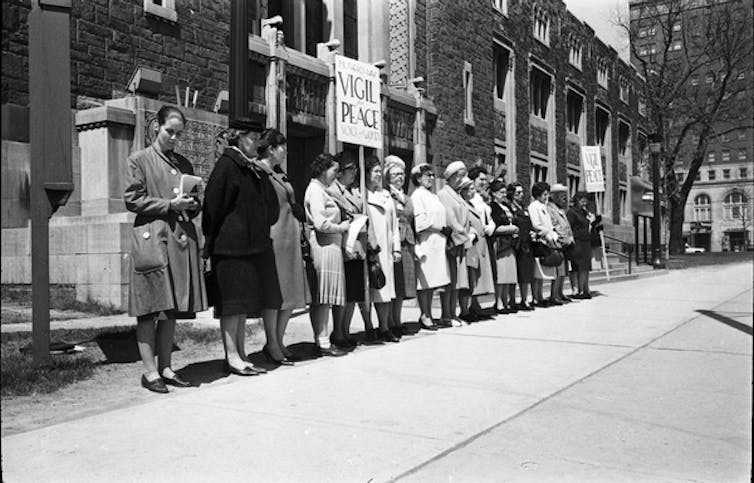
Mother’s Day Vigil for Peace outside the Royal Ontario Museum in Toronto by Voice of Women a Canadian peace group, May 11, 1963.


Today is Mothers’ Day –
a time we set aside to honor the women who have meant so much to us.
In the culture around us, Mothers’ Day has taken a turn from its original intention,
and for the past few years in this church we have tried to say that Mothers’ Day isn’t just about the woman who gave birth to us,
but it is about remembering and honoring all women of faith who have affected us in our personal lives and throughout history.

In the world around us today, Mothers’ Day is a pretty big deal.  
Hallmark plans for 150 million greeting cards to be exchanged today.
More telephone calls are made today than any other day of the year.
An average of $150 will be spent on gifts today – did you get yours?
The Saturday before Mothers’ Day is the busiest day of the year at the car wash.
And the week before Mothers’ Day is the busiest sales time for Veronica’s Secret stores.
!!!!!?????!!!!!

It is good and right for us to take time to think about the woman in our lives who brought us up,
taught us values,
gave us life,
encouraged us along our way.  
But, you know, there is something about Mothers’ Day that has gotten lost over the years.

Mother's Day originally was not the kind of day it has become.
It was not invented by Hallmark cards or the association of retail florists.
It was not originally conceived of as a day to give presents to Mother and bring her breakfast in bed. Not that there's anything wrong with those activities, but that was not the original purpose of Mother's Day.

Mothers' Day [note the difference in spelling] in North America goes back to at least 1858 when Anna Reeves Jarvis organised a Mothers' Day in West Virginia to urge the authorities to improve sanitation for the people who lived in the Appalachians.
Out of that initial effort came a group of women that provided medical services for soldiers and civilians on both sides of the Civil War.  
Just after the war, Anna Jarvis organized a “Mother’s Friendship Day” in which mothers from both North and South whose sons had died in battle came, each dressed in blue or gray and held hands and sang together.

In 1870, poet/philanthropist Julia Ward Howe proposed that there be an annual Mothers' Day for Peace.
Remember after seeing the horrors of a battle, she wrote The Battle Hymn of the Republic – never intended as a fight song, by the way.  
Julia Ward Howe was horrified at the slaughter caused by the battles of the Civil War, and at the slaughter that was taking place in the Franco-Prussian war in Europe.
And she called for the observance of a Mothers' Day.
It was her intent that women everywhere should show their opposition to military conflict.
She said, "Why do not the mothers of mankind interfere in these matters to prevent the waste of that human life of which they alone bear and know the cost."
The Mothers' Day movement that she organised continued to have an annual celebration in the Northeastern United States until the turn of the twentieth  century.

In 1908, Anna Jarvis’s daughter, also named Anna Jarvis, organized a Mother’s Day at her church in West Virginia.  
She wanted to recognize the unappreciated work that mothers do and to call for peace in the home and in the world.  
Word of a good idea traveled fast.
The very next year, Mother’s Day was celebrated in 45 states!

In 1914 the Congress of the United States formally adopted an annual Mother's Day celebration, but not surprisingly they established it as a festival of home and family life rather than as a protest against the horror and senseless slaughter of military conflict.


Wednesday, December 30, 2020

For The Time Being


Poet W.H. Auden wrote For the Time Being: A Christmas Oratorio in 1941 and 42 in war-torn England.
For over fifty Christmases I have read this poem - sometimes to myself, sometimes with family, sometimes with congregations I have served.  Needless to say, it speaks to me in a profound way.  And I share it here with you that you might find some inspiration.
 
Well, so that is that. Now we must dismantle the tree,
Putting the decorations back into their cardboard boxes --
Some have got broken -- and carrying them up to the attic.

 
The holly and the mistletoe must be taken down and burnt,
And the children got ready for school. There are enough
Left-overs to do, warmed-up, for the rest of the week --
Not that we have much appetite, having drunk such a lot,
Stayed up so late, attempted -- quite unsuccessfully --
To love all of our relatives, and in general
Grossly overestimated our powers. Once again
As in previous years we have seen the actual Vision and failed
To do more than entertain it as an agreeable
Possibility, once again we have sent Him away,
Begging though to remain His disobedient servant,
The promising child who cannot keep His word for long.


The Christmas Feast is already a fading memory,
And already the mind begins to be vaguely aware
Of an unpleasant whiff of apprehension at the thought
Of Lent and Good Friday which cannot, after all, now
Be very far off. But, for the time being, here we all are,
Back in the moderate Aristotelian city
Of darning and the Eight-Fifteen, where Euclid's geometry
And Newton's mechanics would account for our experience,
And the kitchen table exists because I scrub it.
It seems to have shrunk during the holidays. The streets
Are much narrower than we remembered; we had forgotten
The office was as depressing as this. To those who have seen
The Child, however dimly, however incredulously,
The Time Being is, in a sense, the most trying time of all.
For the innocent children who whispered so excitedly
Outside the locked door where they knew the presents to be
Grew up when it opened. Now, recollecting that moment
We can repress the joy, but the guilt remains conscious;
Remembering the stable where for once in our lives
Everything became a You and nothing was an It.
And craving the sensation but ignoring the cause,
We look round for something, no matter what, to inhibit
Our self-reflection, and the obvious thing for that purpose
Would be some great suffering. So, once we have met the Son,
We are tempted ever after to pray to the Father;
"Lead us into temptation and evil for our sake."
They will come, all right, don't worry; probably in a form
That we do not expect, and certainly with a force
More dreadful than we can imagine. In the meantime
There are bills to be paid, machines to keep in repair,
Irregular verbs to learn, the Time Being to redeem
From insignificance. The happy morning is over,
The night of agony still to come; the time is noon:
When the Spirit must practice his scales of rejoicing
Without even a hostile audience, and the Soul endure
A silence that is neither for nor against her faith
That God's Will will be done, That, in spite of her prayers,
God will cheat no one, not even the world of its triumph.

IV
Chorus

He is the Way.
Follow Him through the Land of Unlikeness;
You will see rare beasts, and have unique adventures.

He is the Truth.
Seek Him in the Kingdom of Anxiety;
You will come to a great city that has expected your return for years.

He is the Life.
Love Him in the World of the Flesh;
And at your marriage all its occasions shall dance for joy.

-- W. H. Auden

Every Day Is the Best Day In the Year


Back when I served as pastor to a congregation, I sent out a message such as this to them.  I think it is a message we still need to hear at the end of this most disturbing year, and I invite you to read it.

It is good that we begin a new year every year about this time, don’t you think?

As strange as it might seem, the new year did not always begin on January 1!

To be sure, there almost always has been a celebration of the beginning of the new year, but it used to begin March 25.  Yep, going back to the ancient Babylonians, some 4000 years ago, and for long periods of time since then, folks celebrated the new year in conjunction with Spring – marking the end of winter and the beginning of new growth.

In fact, it wasn’t until 1752 that England decreed that January 1 would mark the beginning of the new year there and in the colonies.
But, still, the fact is that most people in the world do not mark the beginning of the new year on January 1.
Jews the world over mark the beginning of the new year in September or October.
Hindus in different parts of India celebrate the new year on various dates.
Muslims use a calendar that has 354 days in most years so their new year falls on different dates as well.
The Chinese New Year begins between January 21 and February 19.
The Thai New Year is celebrated in April 13 to April 15.
The Vietnamese New Year is the Têt Nguyen Dan and is celebrated on the same day as Chinese New Year.

But, we take time just after the darkest time of the year, just as the days get longer, as things change, as more and more light illumines our lives,
to remember where we’ve been,
to remember what we’ve done,
to remember what has happened,
perhaps to evaluate our experiences,
perhaps to celebrate the moments of epiphany,
perhaps to grieve at what has been lost,
and then to look ahead to the days to come.

It is in the looking ahead that our faith gets expressed.
One study has concluded that on average each American makes 1.8 New Year’s resolutions each year.
Well, I know some don’t make any resolutions, because they don’t need the guilt attached to failed expectations. 
But, resolutions can be powerful tools for behavior and attitudinal change. 
I have seen it work time and time again.
Resolutions can be powerful tools if you write them down.
Resolutions can be powerful tools if you display them prominently on the refrigerator door or the bedroom mirror.
Resolutions can be powerful tools if you refer to them daily,
if you say them out loud,
if you include them in your prayers.

New Year’s Day may be the most active-minded holiday, because it is the one where people evaluate their lives and plan and resolve to take some kind of action.

It is no accident that the ancient Romans named this month January – after Janus, the god of gates, doors, and beginnings. 
Janus is always depicted as having two faces, one looking forward and one looking backward. 
And, that’s what we do, isn’t it? 
We look back on the days past. 
And we look forward to the days to come.

As we look forward to the days to come, let us remember that the Psalmist reminds us that each of our days are God-given.  What we do with them is up to us. How we spend them is up to us.  How we get through them is up to us.

Frets and anxieties and regrets have a way of festering and infecting our lives with unhealthiness.  Let’s rid ourselves of them. Misplaced allegiances and unrecognized debts foster unhappiness, unpleasantness and, ultimately, an unfulfilled life.

Let us follow the clue left by Ralph Waldo Emerson:
Write it on your heart that every day is the best day in the year.
Because, that’s what we believe, isn’t it?
That’s what we hear and say each Sunday in churches.

He or she is rich who owns the day,
and no one owns the day who allows it to be invaded with fret and anxiety.
Finish every day and be done with it.
Some blunders and absurdities
no doubt crept in.
Forget them as soon as you can;
tomorrow is a new day;
begin it well and serenely,
with too high a spirit to be encumbered with your old nonsense.
The new day is too dear, with its hopes and invitations, to waste a moment on the yesterdays.


Yes! Yes! Yes!  With its hopes and invitations, the new day is too dear to waste a moment on the yesterdays. 

This is a call to each of us.

Why Is This Night Different from All the Other Nights?


It’s a good thing we begin a new year every year about this time, don’t you think?

If properly approached, the beginning of a new year can be beneficial to our psyche,
beneficial to our health, and beneficial to our soul.

However, as the years go by, Father Time becomes more of a caricature, and we pay less and less attention to the intention  of the season, don’t we?

Without the fol-de-rol of late night parties, New year’s Eve is of little importance to the on-going nature of our lives. 
We have no ceremony for this time of year, when a youngster may ask, “Why is this night, of all nights, important to us?” 

But, maybe we should. 
For this could be a teaching moment for all of us.

As I have noted before, most of us carry around way too much baggage.  We tend to tote pounds and pounds of grudges, animosity, resentment, and revenge, don’t we?
 
And, we know it’s unhealthy. 
Doctors tell us. 
Ministers tell us. 
Researchers tell us. 
Some friends tell us. 
Our blood pressure is affected. 
Our cholesterol is affected. 


Our heart rate is affected. 
Our mood is affected. 
Our relationships are affected. 
Our outlook is affected. 
Our immune system is affected. 
We become more prone to disease. 
We become more prone to mental disorder. 
We become more prone to grumpiness. 
And, our life is not what it could be. 
Our life is not what it should be. 
Our life is not what it is promised to be.

Dr. Bernie Siegel reminds us that there seems to be an innate desire in all humans to be reborn, to start again,
to make resolutions and changes we can live up to.

He notes that he sees evidence of this deep seeded desire
“every day in my role as a physician:
People learn they have a limited time to live, and they start their New Year behavior.
They move, change jobs, spend more time with those they love, stop worrying about what everyone else thinks of them, and start to celebrate their life. They are grateful for the time they have to enjoy life and they stop whining about what they wish had happened during the past year.”

So, he notes: we don’t need to wait for that one certain day of the year.

Dr. Siegel suggests that everyday can be the beginning of a new year.
When every evening is New Year’s Eve and every day you awaken is New Year’s Day, you are living life as it was intended.

For me, this is the message of the new year. 

As Paul reminds us in Colossians, it is time to put to death old attitudes and agendas.

Then, the new year has meaning.  

Then, the new life we are promised is closer to being fulfilled.

In this way, we nurture our soul. 
And, when our soul is tended, our health is better and our future is brighter.  
Then, and only then, can we truly welcome the new year and the days ahead. 
We know them to be the fulfillment of God’s time.

This is the day the Lord has made. 

When every evening is New Year’s Eve and every day you awaken is New Year’s Day, you are living life as it was intended

Sunday, December 27, 2020

It's Still Christmas

 Christmastide Meaning - YouTube

So, this is the Third Day of Christmas. 
Christmastide  is the shortest season of the Church year – just 12 days from December 25 to January 6 – the day of Epiphany.
Once again, the church seems out of sync with the rest of the world.
While the prevailing culture around us - and yes, most of us, also - cleaned up the debris from exchanging gifts on “Christmas” day, the church says, “Hold on.”  

Christmas isn’t over on Christmas day. 
There are eleven more days of Christmas!
Eleven more days of Christmas?!!!

No one we know will be celebrating 12 Days of Christmas – much less anything called Epiphany. 
[I’ve never heard a store around here advertising Epiphany sales.] 

But, it is a fact that in many cultures and many countries in the world, Epiphany is a much larger celebration than Christmas day!

Christmas is at the very heart of our faith. 
The stories of our faith that have been passed down through the ages to us speak to the very essence what Christianity is – how we relate to the creator of the universe and how we relate to others around us.

In fact, we really do not know the actual day Jesus was born – apparently it was just not important to those early believers. 
Jesus never talked about it. 
The Disciples never sang happy birthday to Jesus.  

And no one ever shared pictures of the baby Jesus.  
It was not important to them. 

What was important was what they believed was his message and the authority he must have to be delivering the message so clearly and so forcefully.

And, so we need to know, that no matter how good hearing and singing and believing certain things makes us feel –
the real meaning of the season has nothing to do with gifts, or trinkets, or lights, or candles, or trees, or parties, or dinners, or children, or movies, or shopping, or cards, or Santa, or crosses for that matter.

Christmas is for adults.

The key to understanding Christmas is Emmanuel.
Emmanuel is this Hebrew word that means, “God Is With Us”.

It is significant that we recall and remember that at this time in history – during the heyday of the Roman Empire,
in this particular part of world – an out of the way, nondescript place of no significance to anybody –
the ultimate authority of the universe, the Creator of all that is,
broke through the barriers – the walls of the cosmic egg –
and came to live among, alongside, and with us mortal beings. 
God is no longer confined to the highest heavens, or to the other side of the wall,
or to behind the curtain of the holy of holies. 
No, this is about Emmanuel.

God is with us, we say. 
At Christmas we remember the message and we celebrate the exact point when it happened in history. 
But, the kicker is, the real message is, that it didn’t just happen once and that was it. 
God did not simply open the door and say here I am and then leave.
Emmanuel, we say. 
God is with us, we say.
That’s what we remember through the Christmas stories.
And, Emmanuel, we believe.
God is with us – still. 
Today. 
And tomorrow, and all of our tomorrows – 
Every second of every minute of every hour or every day. 


Emmanuel.


- Clyde E. Griffith

Thursday, January 2, 2020

The Time Being


Poet W.H. Auden wrote For the Time Being: A Christmas Oratorio in 1941 and 42 in war-torn England.
For over fifty Christmases I have read this poem - sometimes to myself, sometimes with family, sometimes with congregations I have served.  Needless to say, it speaks to me in a profound way.  And I share it here with you that you might find some inspiration.
 
Well, so that is that. Now we must dismantle the tree,
Putting the decorations back into their cardboard boxes --
Some have got broken -- and carrying them up to the attic.

The holly and the mistletoe must be taken down and burnt,
And the children got ready for school. There are enough
Left-overs to do, warmed-up, for the rest of the week --
Not that we have much appetite, having drunk such a lot,
Stayed up so late, attempted -- quite unsuccessfully --
To love all of our relatives, and in general
Grossly overestimated our powers. Once again
As in previous years we have seen the actual Vision and failed
To do more than entertain it as an agreeable
Possibility, once again we have sent Him away,
Begging though to remain His disobedient servant,
The promising child who cannot keep His word for long.
The Christmas Feast is already a fading memory,
And already the mind begins to be vaguely aware
Of an unpleasant whiff of apprehension at the thought
Of Lent and Good Friday which cannot, after all, now
Be very far off. But, for the time being, here we all are,
Back in the moderate Aristotelian city
Of darning and the Eight-Fifteen, where Euclid's geometry
And Newton's mechanics would account for our experience,
And the kitchen table exists because I scrub it.
It seems to have shrunk during the holidays. The streets
Are much narrower than we remembered; we had forgotten
The office was as depressing as this. To those who have seen
The Child, however dimly, however incredulously,
The Time Being is, in a sense, the most trying time of all.
For the innocent children who whispered so excitedly
Outside the locked door where they knew the presents to be
Grew up when it opened. Now, recollecting that moment
We can repress the joy, but the guilt remains conscious;
Remembering the stable where for once in our lives
Everything became a You and nothing was an It.
And craving the sensation but ignoring the cause,
We look round for something, no matter what, to inhibit
Our self-reflection, and the obvious thing for that purpose
Would be some great suffering. So, once we have met the Son,
We are tempted ever after to pray to the Father;
"Lead us into temptation and evil for our sake."
They will come, all right, don't worry; probably in a form
That we do not expect, and certainly with a force
More dreadful than we can imagine. In the meantime
There are bills to be paid, machines to keep in repair,
Irregular verbs to learn, the Time Being to redeem
From insignificance. The happy morning is over,
The night of agony still to come; the time is noon:
When the Spirit must practice his scales of rejoicing
Without even a hostile audience, and the Soul endure
A silence that is neither for nor against her faith
That God's Will will be done, That, in spite of her prayers,
God will cheat no one, not even the world of its triumph.

IV
Chorus

He is the Way.
Follow Him through the Land of Unlikeness;
You will see rare beasts, and have unique adventures.

He is the Truth.
Seek Him in the Kingdom of Anxiety;
You will come to a great city that has expected your return for years.

He is the Life.
Love Him in the World of the Flesh;
And at your marriage all its occasions shall dance for joy.

-- W. H. Auden

Wednesday, January 1, 2020

New Year's Day


From the Pastor:

It is good that we begin a new year every year about this time, don’t you think?

As strange as it might seem, the new year did not always begin on January 1!

To be sure, there almost always has been a celebration of the beginning of the new year, but it used to begin March 25.  Yep, going back to the ancient Babylonians, some 4000 years ago, and for long periods of time since then, folks celebrated the new year in conjunction with Spring – marking the end of winter and the beginning of new growth.

In fact, it wasn’t until 1752 that England decreed that January 1 would mark the beginning of the new year there and in the colonies.
But, still, the fact is that most people in the world do not mark the beginning of the new year on January 1.
Jews the world over mark the beginning of the new year in September or October.
Hindus in different parts of India celebrate the new year on various dates.
Muslims use a calendar that has 354 days in most years so their new year falls on different dates as well.
The Chinese New Year begins between January 21 and February 19.
The Thai New Year is celebrated in April 13 to April 15.
The Vietnamese New Year is the Têt Nguyen Dan and is celebrated on the same day as Chinese New Year.

But, we take time just after the darkest time of the year, just as the days get longer, as things change, as more and more light illumines our lives,
to remember where we’ve been,
to remember what we’ve done,
to remember what has happened,
perhaps to evaluate our experiences,
perhaps to celebrate the moments of epiphany,
perhaps to grieve at what has been lost,
and then to look ahead to the days to come.

It is in the looking ahead that our faith gets expressed.
One study has concluded that on average each American makes 1.8 New Year’s resolutions each year.
Well, I know some don’t make any resolutions, because they don’t need the guilt attached to failed expectations. 
But, resolutions can be powerful tools for behavior and attitudinal change. 
I have seen it work time and time again.
Resolutions can be powerful tools if you write them down.
Resolutions can be powerful tools if you display them prominently on the refrigerator door or the bedroom mirror.
Resolutions can be powerful tools if you refer to them daily,
if you say them out loud,
if you include them in your prayers.

New Year’s Day may be the most active-minded holiday, because it is the one where people evaluate their lives and plan and resolve to take some kind of action.

It is no accident that the ancient Romans named this month January – after Janus, the god of gates, doors, and beginnings. 
Janus is always depicted as having two faces, one looking forward and one looking backward. 
And, that’s what we do, isn’t it? 
We look back on the days past. 
And we look forward to the days to come.

As we look forward to the days to come, let us remember that the Psalmist reminds us that each of our days are God-given.  What we do with them is up to us. How we spend them is up to us.  How we get through them is up to us.

Frets and anxieties and regrets have a way of festering and infecting our lives with unhealthiness.  Let’s rid ourselves of them. Misplaced allegiances and unrecognized debts foster unhappiness, unpleasantness and, ultimately, an unfulfilled life.

Let us follow the clue left by Ralph Waldo Emerson:
Write it on your heart that every day is the best day in the year.
Because, that’s what we believe, isn’t it?
That’s what we hear and say each Sunday in church.

He or she is rich who owns the day,
and no one owns the day who allows it to be invaded with fret and anxiety.
Finish every day and be done with it.
Some blunders and absurdities
no doubt crept in.
Forget them as soon as you can;
tomorrow is a new day;
begin it well and serenely,
with too high a spirit to be encumbered with your old nonsense.
The new day is too dear, with its hopes and invitations, to waste a moment on the yesterdays.

Yes! Yes! Yes!  With its hopes and invitations, the new day is too dear to waste a moment on the yesterdays.

This is a call to each of us.
This is a call to our church.

Resolve to pray for your church each day in 2011
Resolve to pray for all who worship here in 2011.
Resolve to pray for those who need to hear the message we proclaim in 2011.

See you in Church,


Clyde

Tuesday, December 31, 2019

Why is this night, of all nights, important to us?


It’s a good thing we begin a new year every year about this time, don’t you think?

If properly approached, the beginning of a new year can be beneficial to our psyche,
beneficial to our health, and beneficial to our soul.

However, as the years go by, Father Time becomes more of a caricature, and we pay less and less attention to the intention  of the season, don’t we?

Without the fol-de-rol of late night parties, New year’s Eve is of little importance to the on-going nature of our lives. 
We have no ceremony for this time of year, when a youngster may ask, “Why is this night, of all nights, important to us?” 

But, maybe we should. 
For this could be a teaching moment for all of us.

As I have noted before, most of us carry around way too much baggage.  We tend to tote pounds and pounds of grudges, animosity, resentment, and revenge, don’t we?
 
And, we know it’s unhealthy. 
Doctors tell us. 
Ministers tell us. 
Researchers tell us. 
Some friends tell us. 
Our blood pressure is affected. 
Our cholesterol is affected. 


Our heart rate is affected. 
Our mood is affected. 
Our relationships are affected. 
Our outlook is affected. 
Our immune system is affected. 
We become more prone to disease. 
We become more prone to mental disorder. 
We become more prone to grumpiness. 
And, our life is not what it could be. 
Our life is not what it should be. 
Our life is not what it is promised to be.

Dr. Bernie Siegel reminds us that there seems to be an innate desire in all humans to be reborn, to start again,
to make resolutions and changes we can live up to.

He notes that he sees evidence of this deep seeded desire
“every day in my role as a physician:
People learn they have a limited time to live, and they start their New Year behavior.
They move, change jobs, spend more time with those they love, stop worrying about what everyone else thinks of them, and start to celebrate their life. They are grateful for the time they have to enjoy life and they stop whining about what they wish had happened during the past year.”

So, he notes: we don’t need to wait for that one certain day of the year.

Dr. Siegel suggests that everyday can be the beginning of a new year.
When every evening is New Year’s Eve and every day you awaken is New Year’s Day, you are living life as it was intended.

For me, this is the message of the new year. 

As Paul reminds us in Colossians, it is time to put to death old attitudes and agendas.

Then, the new year has meaning.  

Then, the new life we are promised is closer to being fulfilled.

In this way, we nurture our soul. 
And, when our soul is tended, our health is better and our future is brighter.  
Then, and only then, can we truly welcome the new year and the days ahead. 
We know them to be the fulfillment of God’s time.

This is the day the Lord has made. 

When every evening is New Year’s Eve and every day you awaken is New Year’s Day, you are living life as it was intended

Sunday, December 29, 2019

The Fifth Day of Christmas


So, this is the Fifth Day of Christmas. 
Christmastide  is the shortest season of the Church year – just 12 days from December 25 to January 6 – the day of Epiphany.
Once again, the church seems out of sync with the rest of the world.
While the prevailing culture around us - and yes, most of us, also - cleaned up the debris from exchanging gifts on “Christmas” day, the church says, “Hold on.”  

Christmas isn’t over on Christmas day. 
There are eleven more days of Christmas!
Eleven more days of Christmas?!!!

No one we know will be celebrating 12 Days of Christmas – much less anything called Epiphany. 
[I’ve never heard a store around here advertising Epiphany sales.] 

But, it is a fact that in many cultures and many countries in the world, Epiphany is a much larger celebration than Christmas day!

Christmas is at the very heart of our faith. 
The stories of our faith that have been passed down through the ages to us speak to the very essence what Christianity is – how we relate to the creator of the universe and how we relate to others around us.

In fact, we really do not know the actual day Jesus was born – apparently it was just not important to those early believers. 
Jesus never talked about it. 
The Disciples never sang happy birthday to Jesus.  

And no one ever shared pictures of the baby Jesus.  
It was not important to them. 

What was important was what they believed was his message and the authority he must have to be delivering the message so clearly and so forcefully.

And, so we need to know, that no matter how good hearing and singing and believing certain things makes us feel –
the real meaning of the season has nothing to do with gifts, or trinkets, or lights, or candles, or trees, or parties, or dinners, or children, or movies, or shopping, or cards, or Santa, or crosses for that matter.

Christmas is for adults.

The key to understanding Christmas is Emmanuel.
Emmanuel is this Hebrew word that means, “God Is With Us”.

It is significant that we recall and remember that at this time in history – during the heyday of the Roman Empire,
in this particular part of world – an out of the way, nondescript place of no significance to anybody –
the ultimate authority of the universe, the Creator of all that is,
broke through the barriers – the walls of the cosmic egg –
and came to live among, alongside, and with us mortal beings. 
God is no longer confined to the highest heavens, or to the other side of the wall,
or to behind the curtain of the holy of holies. 
No, this is about Emmanuel.

God is with us, we say. 
At Christmas we remember the message and we celebrate the exact point when it happened in history. 
But, the kicker is, the real message is, that it didn’t just happen once and that was it. 
God did not simply open the door and say here I am and then leave.
Emmanuel, we say. 
God is with us, we say.
That’s what we remember through the Christmas stories.
And, Emmanuel, we believe.
God is with us – still. 
Today. 
And tomorrow, and all of our tomorrows – 
Every second of every minute of every hour or every day. 


Emmanuel.


- Clyde E. Griffith